
2026-09-08
News
Making structured depression screening easier across language barriers.
Talking about mental health requires trust, time and clear communication. When a healthcare professional and patient do not speak the same language, even a short, standardized questionnaire can become difficult to use. Staff may need to search for a translated form, switch between different tools or translate each question separately – all while trying to keep the conversation calm and focused on the patient.
That is why the PHQ-9 is now available directly in Care to Translate. The new in-app content gives healthcare professionals a simple way to support multilingual depression screening within the same medical translation app they already use for patient communication.
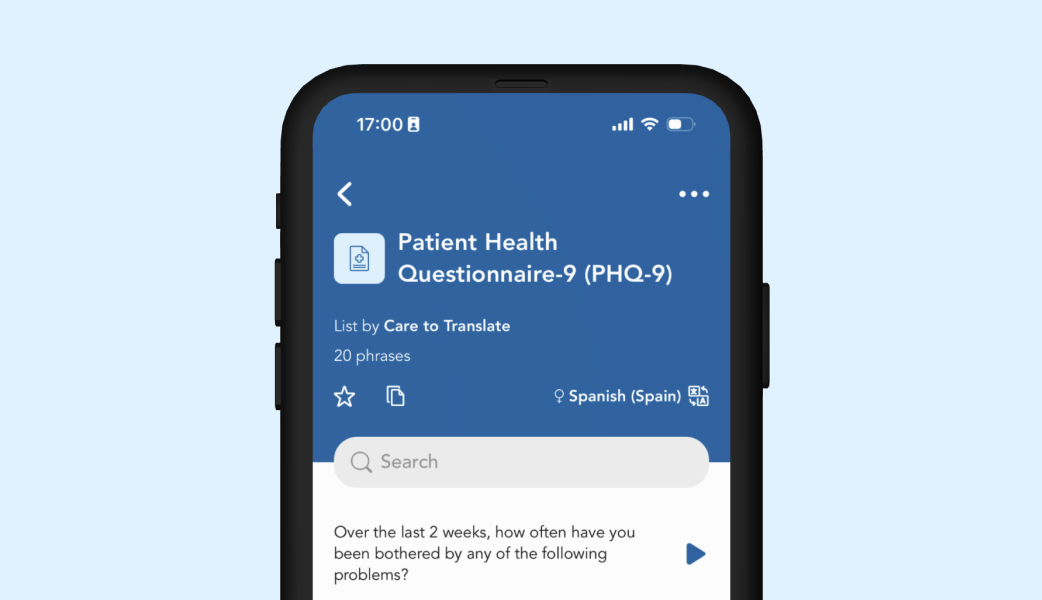
The Patient Health Questionnaire-9, usually called the PHQ-9, is a widely used questionnaire for screening and measuring the severity of depressive symptoms. It asks patients about nine symptoms and how frequently they have experienced them during the previous two weeks. It can also be repeated to help monitor changes in symptoms over time.
The PHQ-9 is designed to support clinical assessment – it does not establish a diagnosis on its own. The results should always be considered alongside the patient’s history, circumstances and a healthcare professional’s clinical judgment. You can read more in the original PHQ-9 validation study.
Healthcare professionals can open the PHQ-9 in Care to Translate, select an available language and guide the patient through the questions and response options without leaving the app.
This helps you:
The patient’s responses can then be scored, documented and followed up according to your organization’s existing clinical routines. Like the other ready-made content in our medical phrase library, the multilingual PHQ-9 is designed to make a common healthcare workflow easier to access when language barriers arise.
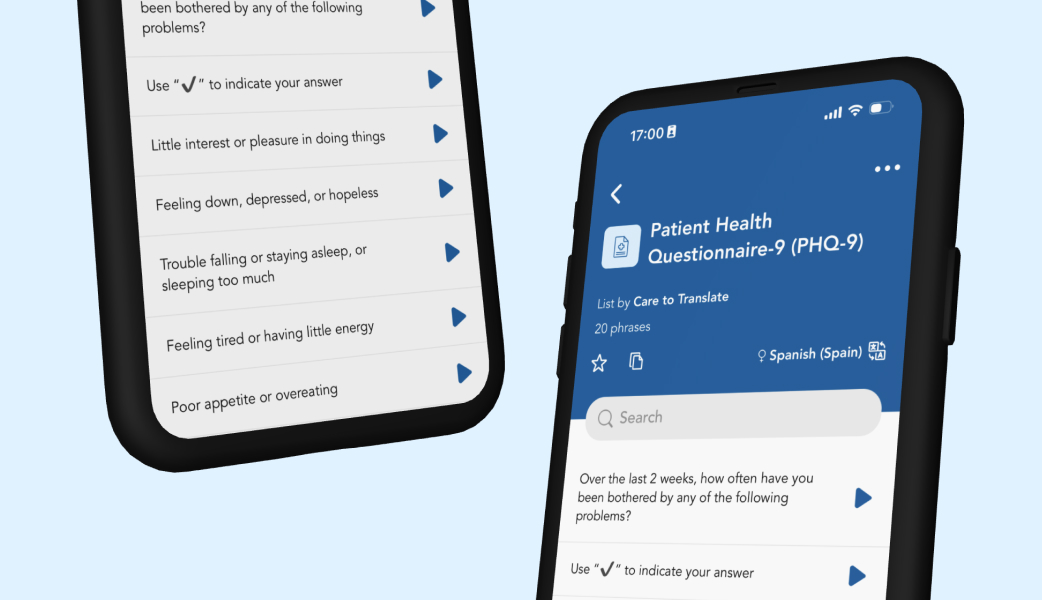
The PHQ-9 can support healthcare professionals in several situations, including:
The questionnaire can help you begin the assessment, but it should never replace a complete clinical evaluation or the professional judgment of the healthcare provider.
The ninth item of the PHQ-9 concerns thoughts of death or self-harm. Any response indicating a possible risk requires appropriate clinical follow-up in line with your organization’s safeguarding and emergency procedures.
If a response is unclear, or the conversation develops into a more complex or sensitive assessment, use the language support appropriate to the situation. This may include continuing with real-time translation or involving a professional interpreter according to local policy.
Care to Translate supports communication during the assessment. It does not provide a diagnosis or replace established clinical and patient-safety procedures.
The multilingual PHQ-9 is available in Care to Translate now. Open the app and search for PHQ-9 to get started.
Not using Care to Translate yet? Learn how to get started or contact our team to explore how Care to Translate can support multilingual communication in your organization.