
2026-09-28
News
Supporting structured emergency and neurological assessments across language barriers.
In emergency care, getting the right information quickly matters. When a patient and healthcare professional do not speak the same language, even a familiar assessment can become more difficult to work through.
To make these situations easier to navigate, we have added four new clinical checklists to Care to Translate: AMPLER, S-OPQRST, NIHSS and GCS.
The new phrases provide healthcare professionals with multilingual communication support for commonly used emergency and neurological assessments.
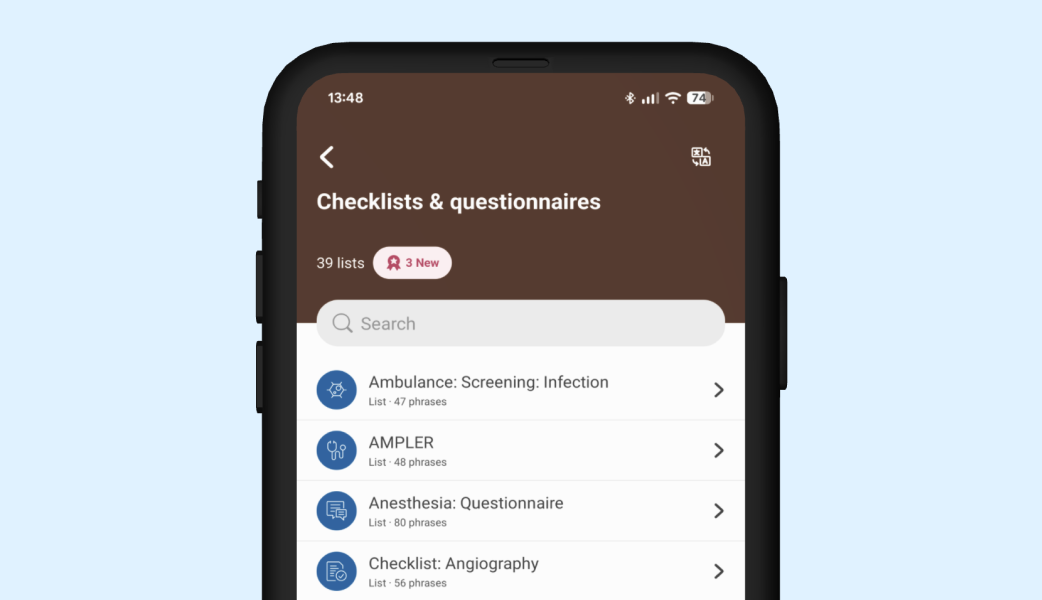
The new checklists are designed to support two broad areas of assessment: emergency and trauma situations, and neurological assessment.
AMPLER provides a structured approach to gathering important information from a patient during an emergency assessment. This helps healthcare professionals systematically work through relevant aspects of the patient's history, such as Allergies, Medications, Past medical history/Pregnancy, Last oral intake, Events leading up to the illness or injury, and Risk factors.
S-OPQRST provides a structured way to assess a patient's symptoms and is commonly used in emergency and pre-hospital care. OPQRST guides questions about Onset, Provocation/Palliation, Quality, Region/Radiation, Severity and Time, while the initial S addresses Signs and Symptoms.
For example, it can help healthcare professionals establish when a symptom started, what makes it better or worse, where it is located and how severe it is.
The National Institutes of Health Stroke Scale (NIHSS) is a 15-item standardized tool used by healthcare professionals to assess neurological impairment, particularly when stroke is suspected.
The Glasgow Coma Scale (GCS) is a standardized 15-point clinical tool used to assess a patient’s level of consciousness following a brain injury or medical emergency by evaluating eye, verbal and motor responses.
Emergency and neurological assessments are often carried out in situations where healthcare professionals need to gather information quickly and systematically.
When a language barrier is added, completing even familiar assessments can require additional steps. Having relevant, prepared phrases available within the same medical translation app used for other patient communication can help reduce unnecessary switching between tools.
The new checklists can help you:
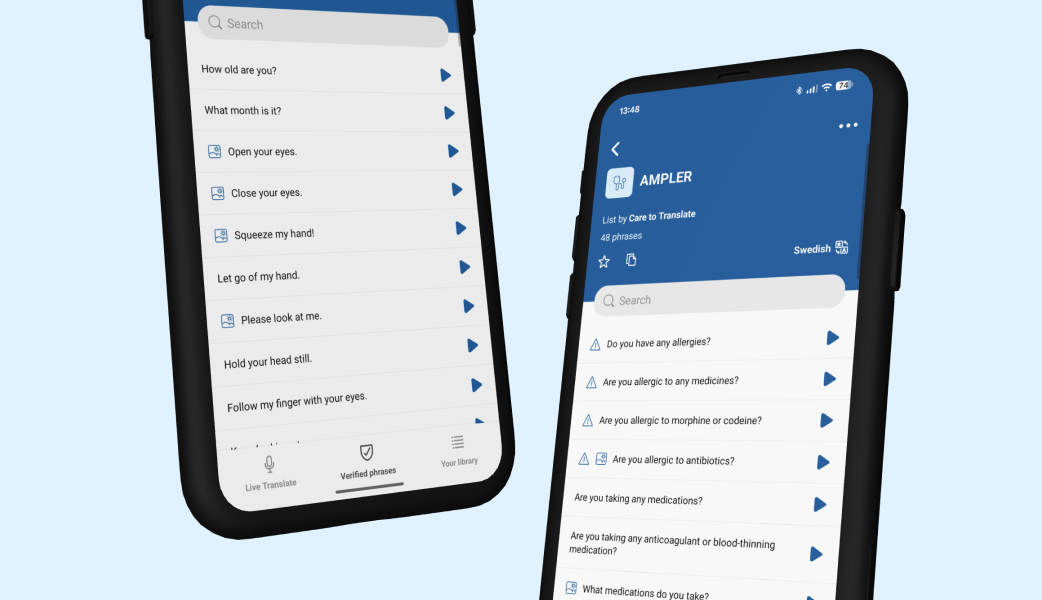
The new checklists are designed to support communication during clinical assessments, not to perform the assessment itself.
Healthcare professionals should continue to follow their organization's established clinical protocols, documentation requirements and escalation procedures. The information communicated through Care to Translate should always be interpreted within the wider clinical context and alongside professional judgment.
The four new checklists are available in Care to Translate.
Go to Checklists and questionnaires in the Phrase library to find AMPLER, S-OPQRST, NIHSS and GCS.
Not using Care to Translate yet? Learn how to get started or contact our team to explore how Care to Translate can support multilingual communication in your organization.