
2026-02-19
Blogg
Interpreter services are essential. But the way we fund, track, and deliver them is often inefficient, and expensive in the wrong places.
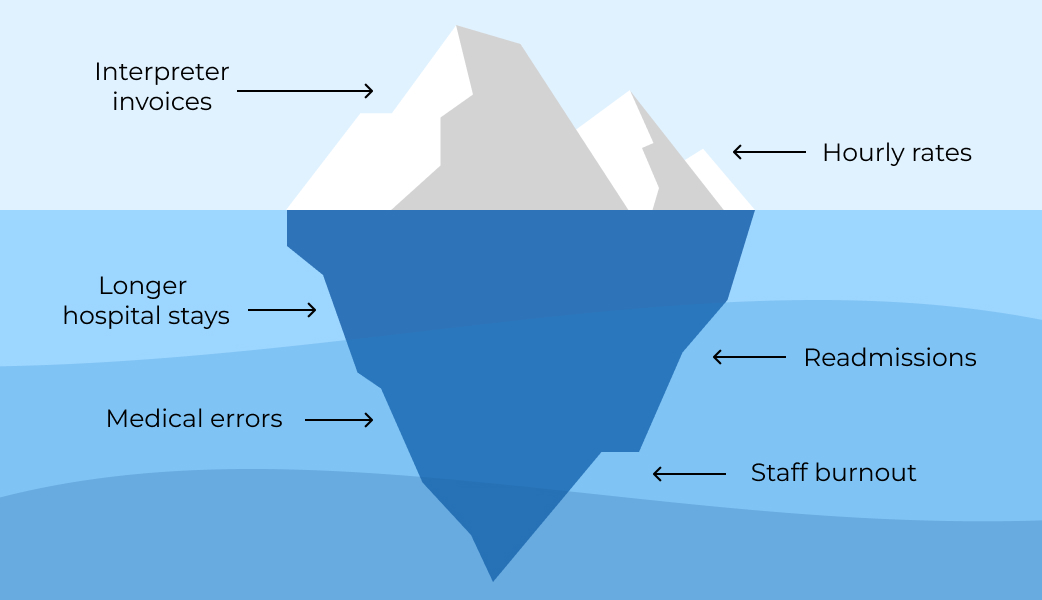
Healthcare systems often debate interpreter costs as if they are a simple line item. Research shows that interpreter spending is relatively modest – and that it pays for itself by reducing avoidable care, shortening hospital stays, and preventing readmissions. This article explains the hidden costs of poor communication, the challenges of interpreter access, and why digital medical translation tools can support more sustainable language access.
Healthcare decision-makers often ask one question first: “How much does an interpreter cost per hour?”
But research summarized in a Swedish report from The Institute for Language and Folklore (Isof) on publicly funded interpreting shows that this is the wrong starting point.
The report emphasizes that direct interpreter costs alone do not reflect the true cost of language barriers in healthcare.
Instead, we should look at total outcomes:
One key conclusion from the report is clear: Interpreter services are not a financial burden, they are a long-term investment.
The report concludes that interpreter costs are relatively small and can lead to long-term gains through fewer future healthcare visits and reduced overall care needs.
The report highlights evidence that professional interpreting can reduce inpatient length of stay when used at key points such as admission and discharge.

A large journal-based study found hospital stays were significantly shorter – between 0.75 and 1.47 days – when qualified interpreters were used.
It also found lower risk of 30-day readmission for patients who received interpreter support.
This is not only a patient safety benefit, it’s also a major cost-saving opportunity.
The report also points out a major structural challenge:
Sweden’s interpreter system is fragmented across regions, municipalities, and state agencies, with different procurement models and limited shared reporting.
It estimates that the total public cost of interpreter training, quality work, oversight, and interpreter services is around two billion SEK per year.
Yet, the report describes the statistical basis for interpreter use as fragmented and insufficient, making it difficult to measure cost-effectiveness properly.
These findings echo a global reality: the "interpreter gap" is not unique to Sweden.
From the US to the UK, healthcare systems face the same paradox – while professional interpretation carries a direct price tag, the "hidden" costs of communication barriers (medical errors, longer stays, and readmission) are far higher. This is an international patient safety problem that demands smarter, scalable digital solutions to bridge the gap.
Digital medical translation and language support tools should not be seen as “replacing interpreters.”

Instead, they can support healthcare systems by:
When interpreter budgets are under pressure, the goal should not be “less language support.”
The goal should be better language support.
When healthcare systems underfund language access, the cost doesn’t disappear.
It simply shifts:
Language access is not a luxury. It’s patient safety and good economics.
If your organization is exploring digital medical translation solutions, we can help you evaluate:
Use our savings calculator to explore how much your organization can save by using our medical translator, compared to using body language and guesswork with your care recipients.

Source: https://www.isof.se/utforska/publikationer/publikationer/2026-02-10-offentligt-finansierad-tolkning-villkor-debatt-forskning