
2026-08-24
Blogg
AI adoption in healthcare is moving at lightspeed, and regulatory enforcement under the EU AI Act is actively rolling out.
Healthcare staff need fast translation tools to communicate effectively with non-native patients. However, using unregulated or consumer AI tools (like generic chatbots or free translation websites) introduces serious legal, privacy, and clinical risks.
Here is a simple, clear guide on what the EU AI Act requires when using AI translation in clinical settings – and how Care to Translate meets these standards.
The EU AI Act is the world’s first legal framework regulating Artificial Intelligence. Much like GDPR, it is a regulation that applies directly across all EU member states.
The law applies to two main groups:
If your hospital or organization only uses AI systems, large portions of the Act intended for software developers won't apply to you. However, you are still responsible for choosing compliant vendors and ensuring your staff use AI safely.
Yes. Under Article 3 of the EU AI Act, tools that process inputs to infer outputs – such as Speech-to-Text (STT), Neural Machine Translation (NMT), and Text-to-Speech (TTS) – are legally classified as AI systems.
The EU AI Act categorizes AI into four risk levels: Unacceptable risk (banned), High risk (strictly regulated), Limited risk (transparency rules), and Minimal risk (unregulated).
Translation tools designed for general clinical communication fall under Limited risk.
Here is why standalone translation tools are not classified as high risk:
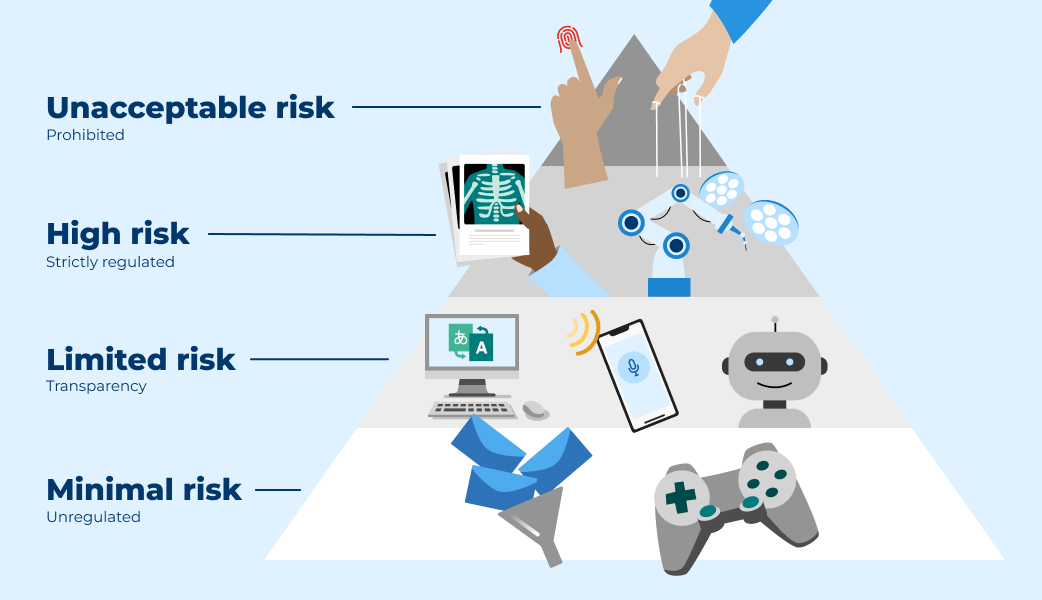
Because AI translation is classified as Limited Risk, three specific areas of the EU AI Act apply directly to healthcare deployers:
Providers and deployers must ensure that users (both healthcare staff and patients) know they are interacting with or receiving text processed by an AI system. Disclosures must be clear and accessible at the first point of interaction.
Organizations using AI must ensure their staff have an adequate level of AI literacy. Staff should understand how to use the tool properly, recognize its limits, and know why unvetted consumer tools should be avoided.
High risk AI systems must never operate without human supervision. The tool must be designed so clinicians can review, understand, and override outputs at any moment, keeping human judgment at the center of patient care.
The EU AI Act isn't designed to stop healthcare providers from using AI – it is designed to stop unmonitored, unsafe AI.
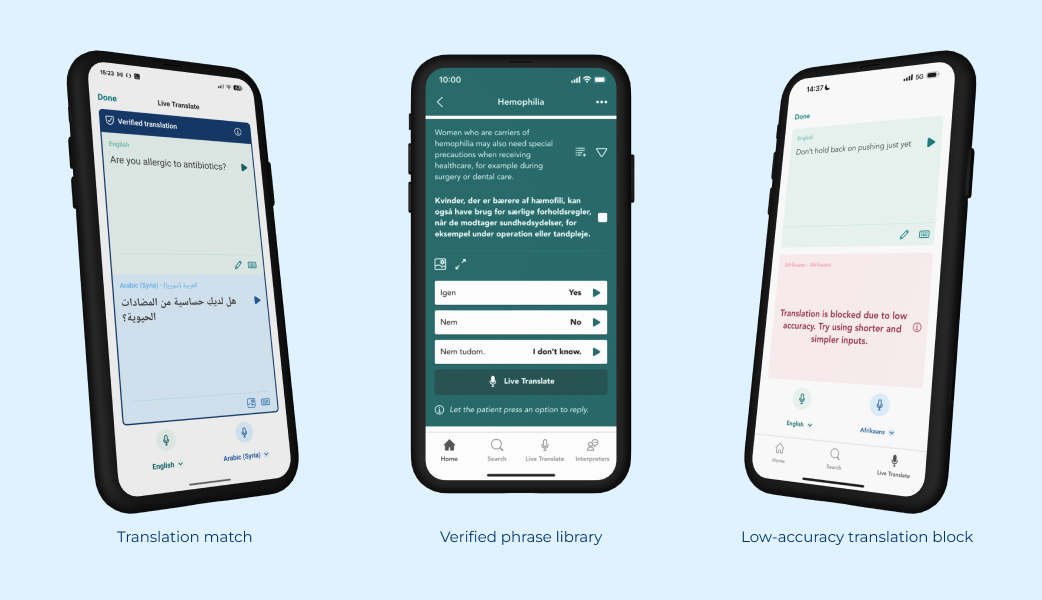
Care to Translate is a purpose-built translation platform engineered specifically for healthcare workflows. Here is how our platform aligns directly with the key requirements of the Act:
Want to review our full compliance documentation, ISO certifications, and data privacy framework? Visit our Trust center or book a demo with our team today.
Yes. Care to Translate is built to fulfill all regulatory requirements for AI translation in clinical settings. It meets Article 50 transparency rules with clear in-app AI disclaimers, protects patient privacy with zero cloud data retention, and safeguards Article 14 human oversight by giving clinicians full control.
A tool being publicly available does not make it approved or compliant for processing healthcare information. Using free consumer tools in healthcare creates a major compliance issue known as "Shadow AI." Free consumer tools routinely store and train on user inputs, which violates GDPR and patient data privacy laws. They also lack medical-grade accuracy controls, audit logs, and compliance mechanisms required by the EU AI Act. Always check with your IT department about what is compliant in your organization.
Under European law, healthcare providers retain legal accountability for patient care. That is why relying on "blind" machine translation is risky. Using purpose-built platforms that combine AI with pre-verified medical phrasebook libraries protects clinicians from automation bias and significantly reduces institutional liability.
No. The EU AI Act complements GDPR. If a translation tool handles personal or health data, full GDPR compliance remains mandatory.
When evaluating translation software for clinical environments, use this checklist to ensure compliance: